Rosanne Freak-Poli
Between Squares
March 6 – 28th, 2026
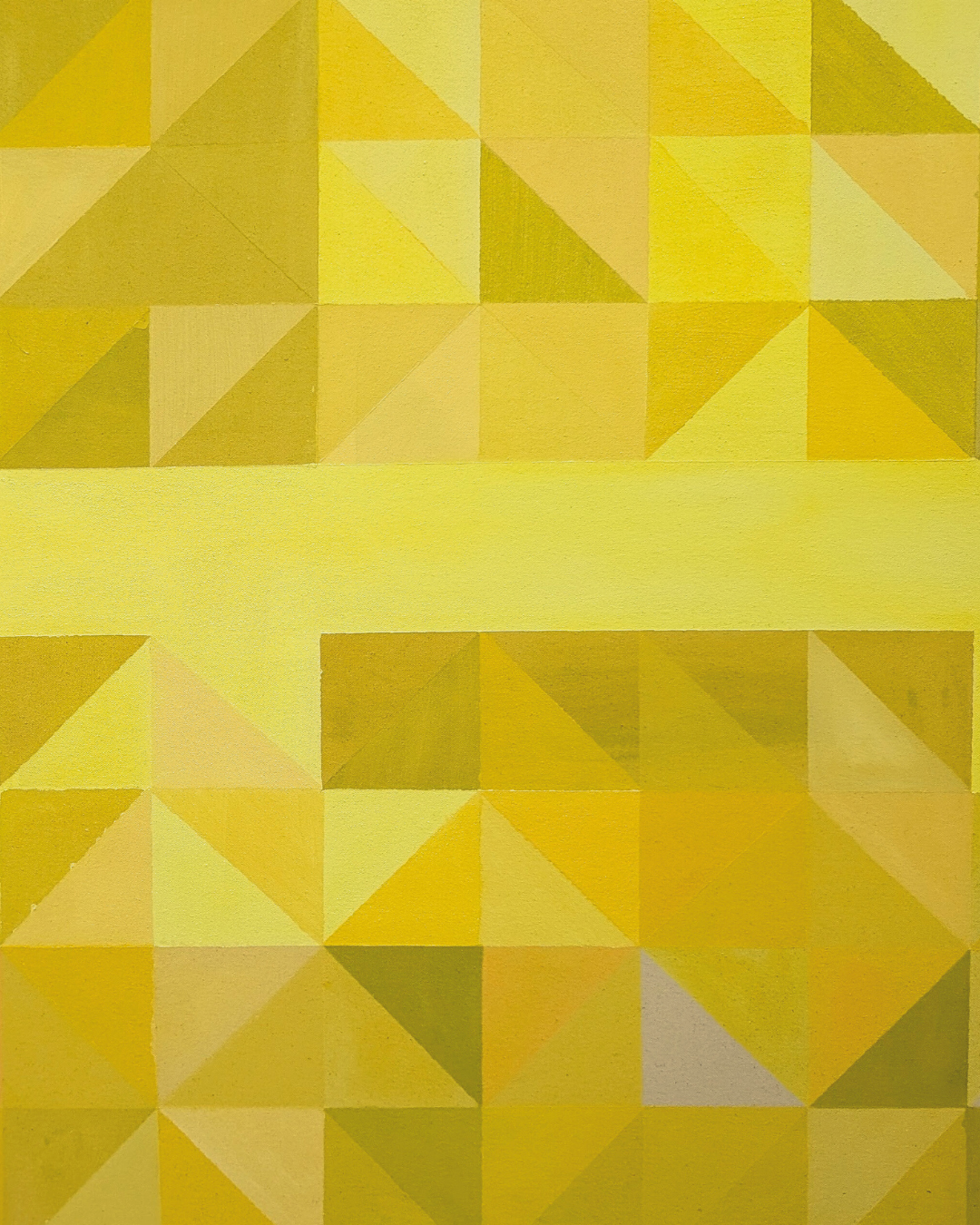
This body of work comprises a series of large-scale paintings on canvas, stretched over pine frames and rendered in a restrained, monochromatic yellow palette that at times borders on green. Each composition is structured through a grid, with every square bisected diagonally to form a repeating triangular motif. While the system appears rigid at first glance, closer inspection reveals subtle irregularities: slight shifts in alignment, tonal variation, and visible brushwork that registers the presence of the artist’s hand.
The paintings are deliberately flat and frontal. Their scale saturates the viewer’s field of vision, producing an optical experience that is immersive yet affectively cool. Rather than inviting expression or narrative, the works operate through repetition, restraint, and tonal modulation. The yellow surface functions less as colour than as atmosphere — steady, muted, and insistently present.
These works draw on a history of geometric abstraction, particularly practices concerned with the grid as both a formal device and a conceptual structure. As articulated in Rosalind Krauss’s writing on the grid, such systems promise order, neutrality, and autonomy, yet inevitably expose their own instability. Here, the grid is neither perfectly mechanical nor fully expressive; its imperfections signal the persistence of difference within an imposed structure.
The diagonal divisions introduce a quiet tension into the compositions, disrupting the grid’s claim to uniformity while maintaining its overall coherence. Repetition becomes a method of both containment and resistance: a way of working within a system while allowing slippage, variation, and looseness to emerge. In this sense, the paintings propose a measured rethinking of structure — one that acknowledges constraint while insisting on the inevitability of divergence.
Freak-Poli is a multi-disciplinary artist whose practice examines systems of value and the social structures that shape how worth is assigned to objects, labour, time, and individuals. Her work often considers the tension between autonomy and productivity, questioning inherited frameworks that privilege efficiency, usefulness, and measurable output.
Her practice is diverse, drawing on the legacies of conceptual art, hard-edge abstraction, and Fluxus. Across painting, performance, and installation, she explores how repetition, restraint, and embodied gesture can reframe everyday actions as sites of meaning. Her work is informed by the practices of artists such as Martin Creed, Mierle Laderman Ukeles, and Andrea Zittel, particularly their sustained inquiries into what constitutes art, labour, and a meaningful life.
Aaron Martin, 2026