KEISUKE MATSUURA:
Since the 1990s, Kyoto-born, Düsseldorf-based artist Keisuke Matsuura has developed a practice that explores geometry through its relationship to natural and environmental phenomena. Beginning with simple structural forms, Matsuura constructs works that reveal how material systems respond to light, air, magnetism, and spatial contingency. His practice investigates the tension between rational order and the unpredictable forces that act upon it.
During his formative years in Tokyo, Matsuura encountered the work of the ZERO artists, whose investigations into light, movement, and immateriality profoundly shaped his thinking. After relocating to Germany in 1997 to study at the Kunstakademie Düsseldorf under Christian Megert and Daniel Buren, he expanded these concerns by situating geometric structures within dynamic environmental contexts. Works such as weiße nepix (Moers, 2011), le nôtre – spiegelungen(Benrath Palace, Düsseldorf, 2012), and Weißer Steinborn (2023) employ fabric, poles, and reflective surfaces that are activated by wind, light, and atmospheric conditions, allowing form to emerge through its susceptibility to change.
Matsuura’s work is informed by the Japanese philosophical concept of ku (?), often translated as “emptiness,” which describes a state of impermanence, interdependence, and latent potential. Rather than signifying absence, ku suggests a field in which subtle energies and transformations occur. This framework underpins Matsuura’s approach, positioning his works as perceptual instruments that reveal otherwise invisible forces operating within space.
Central to this investigation is his ongoing Jiba-Pek series. These monochrome canvases are shaped by concealed magnetic fields generated by magnets placed behind the stretcher. The resulting concave and convex distortions subtly disrupt the canvas surface, producing rhythmic deformations that register the presence of invisible energy. While maintaining formal clarity, the works expose an inherent instability, where geometry becomes both structure and event.
For Melbourne Art Fair 2026, Matsuura presents new works from the Jiba-Pek series that extend this exploration of hidden force and material response. The paintings invite viewers to engage not only with monochrome surfaces, but with the delicate tensions that animate them. Through the interaction of magnetic fields, light, and surrounding environmental conditions, the works generate quiet shifts in perception, revealing the coexistence of precision and contingency.
Matsuura has exhibited internationally in both gallery and site-responsive contexts, with solo exhibitions at Imura Art Gallery (Kyoto), Chabot Fine Art (The Hague), and Stiftung Schloss und Park Benrath (Düsseldorf), as well as installations at Museum Insel Hombroich and the ZERO Foundation, Düsseldorf. His work has been included in major group exhibitions such as the Socle du Monde Biennale (Denmark), Resonance: Walter Leblanc – Keisuke Matsuura(Brussels), and PAN Amsterdam. His works are held in public and institutional collections including the Max Bill Foundation, Stiftung Schloss und Park Benrath, Walter Leblanc Foundation, and Hino Motors.
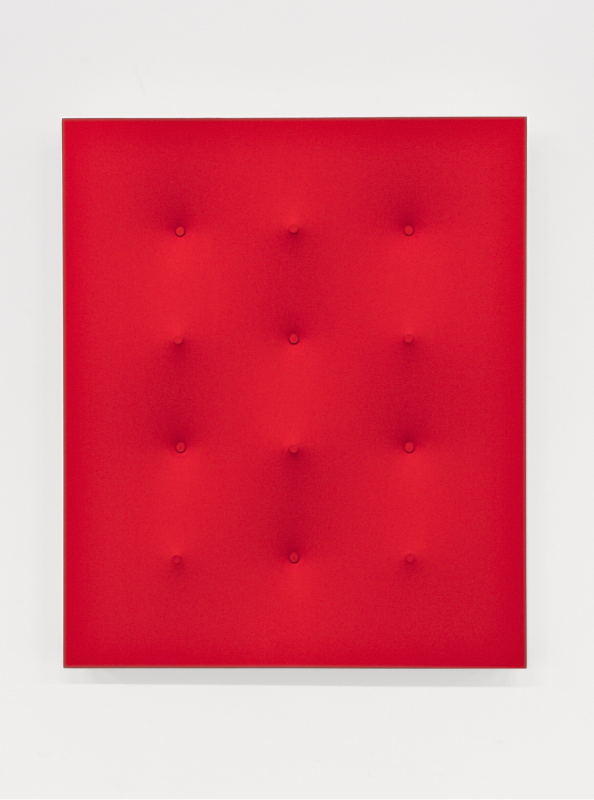
Image: Keisuke Matsuura, Jiba pek15, 2020, magnets, acrylic on canvas, 63 x 53 x 5cm
SEAN HOGAN:
A pigment sprayed. A colour looking for a friend. A painting unseen. A language spoken backwards.
Hogan begins with a single word, image, or gesture—a poetic kernel that sparks his thinking. From this, he develops a framework rooted in system theory and complexity science, drawing on geometry, colour, proportion, and materiality. His works explore dualities such as complexity/simplicity, order/disorder, and connection/disconnection.
In series such as Nevermore, repetition and system-driven sequences allow subtle shifts in time, space, and mood to emerge, producing visual and temporal variation. Hogan’s engagement with contemporary content is evident in works like Volume 1, 2022 (Melbourne Now, NGV), which visualised redacted pages of the Mueller Report as monochrome horizontal lines, exploring the intersections of information, politics, and perception.
For Melbourne Art Fair 2026, Hogan has produced a new body of work titled The Disconnect Paintings. Painted by hand with spray cans—a gesture recalling early cave paintings—these works reference the Roman god Janus, figure of dual perspectives, thresholds, and transition. Each piece is executed in reverse, a form of “blind painting” in which the surface cannot be seen while it is being made, producing spatial disorientation and contingency.
The Disconnect Paintings are constructed in paired panels whose foreground and background colours alternate, creating visual tension and echoing Janus’s dual gaze. The structures are further organised by invisible grids based on musical time signatures, generating a visual discord akin to counterpoint. Titles are drawn from songs reflecting themes of dislocation, alienation, and lost love, extending the rhythmic and emotional underpinnings.
Colour is deliberately limited to two tones per work, drawn from natural, fluorescent, and greyscale palettes. Painted on acrylic sheeting, the surfaces reflect their environment, mirroring viewers and surroundings, and creating a “colourised alternate world”—a threshold space aligned with Janus’s symbolism of passage and transformation.
Across his practice, Hogan investigates the interplay of poetic impulse and ordered systems, producing works in which structure and flux, clarity and disruption, coexist. Nevermore and The Disconnect Paintings invite viewers to experience art as a dynamic negotiation between visible form, invisible forces, and temporal rhythm.
Melbourne-born Sean Hogan (b. 1972) studied Art and Design at Swinburne TAFE before completing a Bachelor of Graphic Design at Swinburne University. He has exhibited at the National Gallery of Victoria (Melbourne Now, 2022–2023), La Trobe Art Institute, and at art fairs including Spring 1883 and Sydney Contemporary. His work is held in major collections including the NGV and Artbank, and he has received recognition through national awards such as the Australian Book Design Award and the Royal Australian Institute of Architects Award.
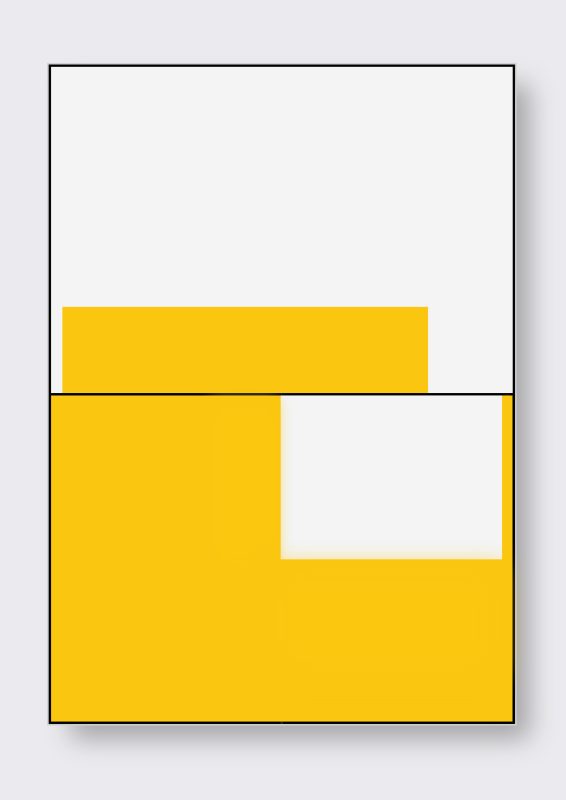
Image: Sean Hogan, Open view, 2025, synthetic polymer aerosol on acrylic sheet, aluminium frame, 86 x 61 cm