SOFT GEOMETRIES
Britt Salt
Sara Lindsay
Shannon Slee
Tia Ansell
July 3rd – 25th, 2026
Soft Geometries brings together four Melbourne-based artists whose practices expand the language of geometric abstraction through textile processes. Working across weaving, stitching, embroidery and textile-based construction, Britt Salt, Shannon Slee, Sara Lindsay and Tia Ansell demonstrate that geometry is not confined to the traditions of painting or formal abstraction, but can emerge through tactile processes of making that are deeply connected to labour, materiality and lived experience.
Across the exhibition, geometry is understood not as a fixed system but as a language that can be woven, stitched, unravelled and reconstructed. Grids, repeated structures and accumulated gestures become vehicles through which each artist explores space, memory, architecture, landscape, community and the body. Precision sits alongside intuition; order gives way to subtle disruption. Collectively, the works reveal how textile practices soften the often-rigid language of abstraction, replacing certainty with tactility, movement and human experience.
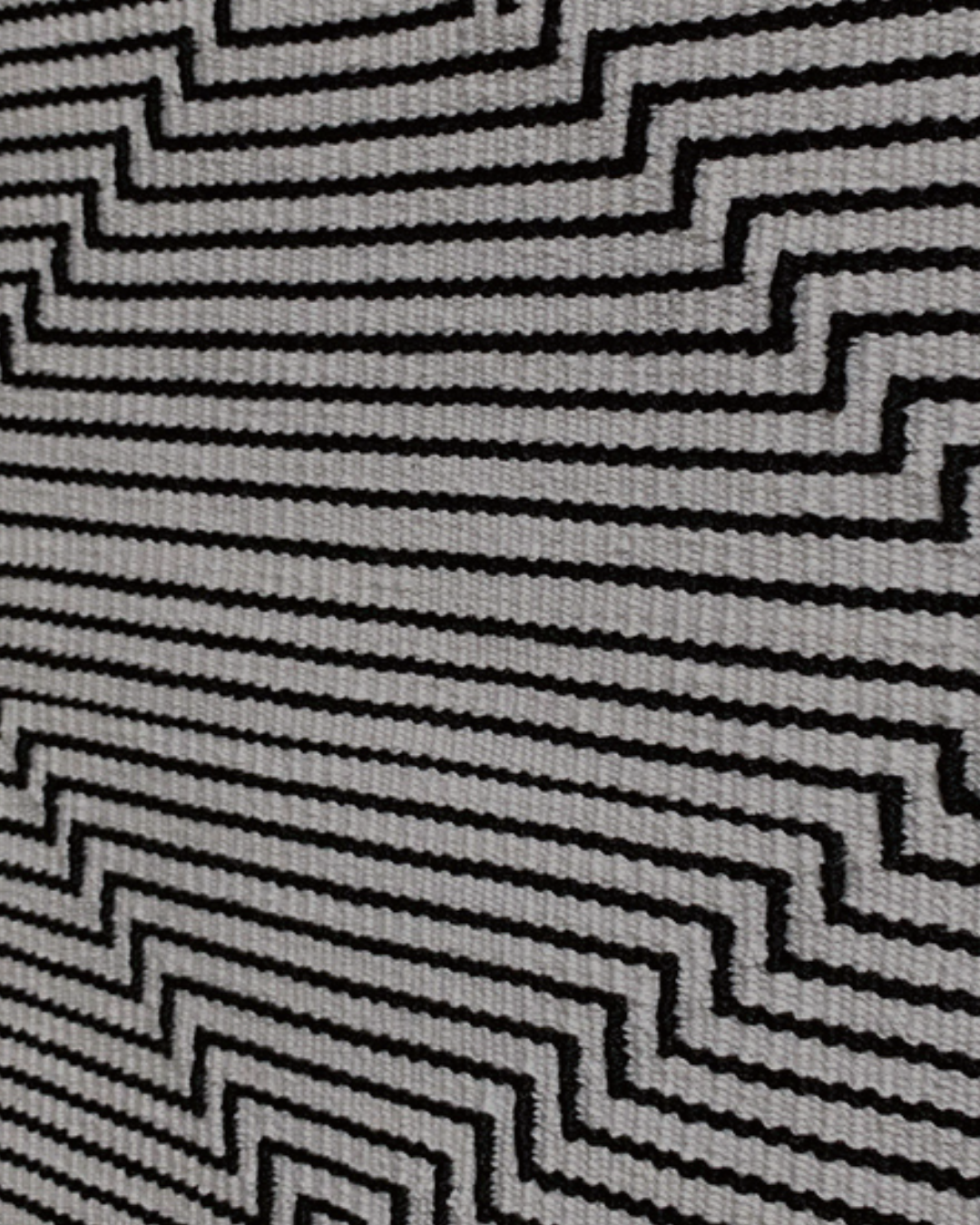
Britt Salt‘s woven works investigate the relationship between geometry, perception and space. Hovering between art and architecture, her tapestries operate as spatial experiments where line, form and structure continually shift through the viewer’s movement. Drawing on intuitive processes of weaving, Salt embraces interruptions within the woven matrix that generate subtle glitches, visual ambiguities and impossible perspectives. Referencing the spatial paradoxes of M.C. Escher, her works challenge the apparent stability of geometric systems, inviting the eye to linger, adjust and ultimately surrender to a space that is simultaneously ordered and elusive.
For Shannon Slee, textile becomes both material and metaphor. Through the slow processes of unpicking, weaving and reconstructing discarded garments, she transforms clothing imbued with personal histories into collective objects that speak to transition, care and shared experience. Her abstract compositions emerge through acts of labour and repair while acknowledging the social histories embedded within textiles. Her ongoing Abortifacients project further extends these ideas by connecting abstract geometries with botanical forms, drawing attention to the historical use of medicinal plants in reproductive healthcare and the overlooked knowledge carried through women’s craft traditions.
Sara Lindsay similarly transforms familiar textiles into complex woven landscapes. Repurposing patterned fabrics, she constructs richly textured tapestries where domestic materials become abstracted topographies. Beneath their formal geometric structures lie reflections on environmental change, regeneration and memory, with woven surfaces echoing agricultural grids, scarred terrains and the rhythms of cultivated landscapes. Her practice reveals the capacity of abstraction to simultaneously evoke place, ecology and lived experience.
Tia Ansell approaches geometry through the visual language of the contemporary city. Drawing inspiration from architectural façades, aerial perspectives and urban planning, her meticulously hand-woven “weaving-paintings” distil complex built environments into refined compositions of line, colour and scale. Woven on a century-old loom, her works translate architectural systems into tactile structures, dissolving conventional boundaries between textile, painting and design.
Together, these four artists demonstrate that geometry is not simply a visual system but a material and conceptual framework through which ideas are constructed, disrupted and reimagined. Soft Geometries proposes textile as a site where abstraction becomes embodied—where woven structures hold memory, architecture, landscape and social histories, and where the measured logic of geometry is continually softened by the intelligence of the hand.
Image: Britt Salt, Neither-Nor, 2021, Wool and cotton, 95 x 84 cm (detail).
Tia Ansell appears courtesy of LON gallery, Melbourne