Christian Capurro
Mimic’s Turn
March 6th – 28th, 2026
Mimic’s Turn brings together works from Christian Capurro’s enclasticine and Disport series, presenting two distinct yet interconnected approaches to the abstracted other lives of figures, tools and pictures.
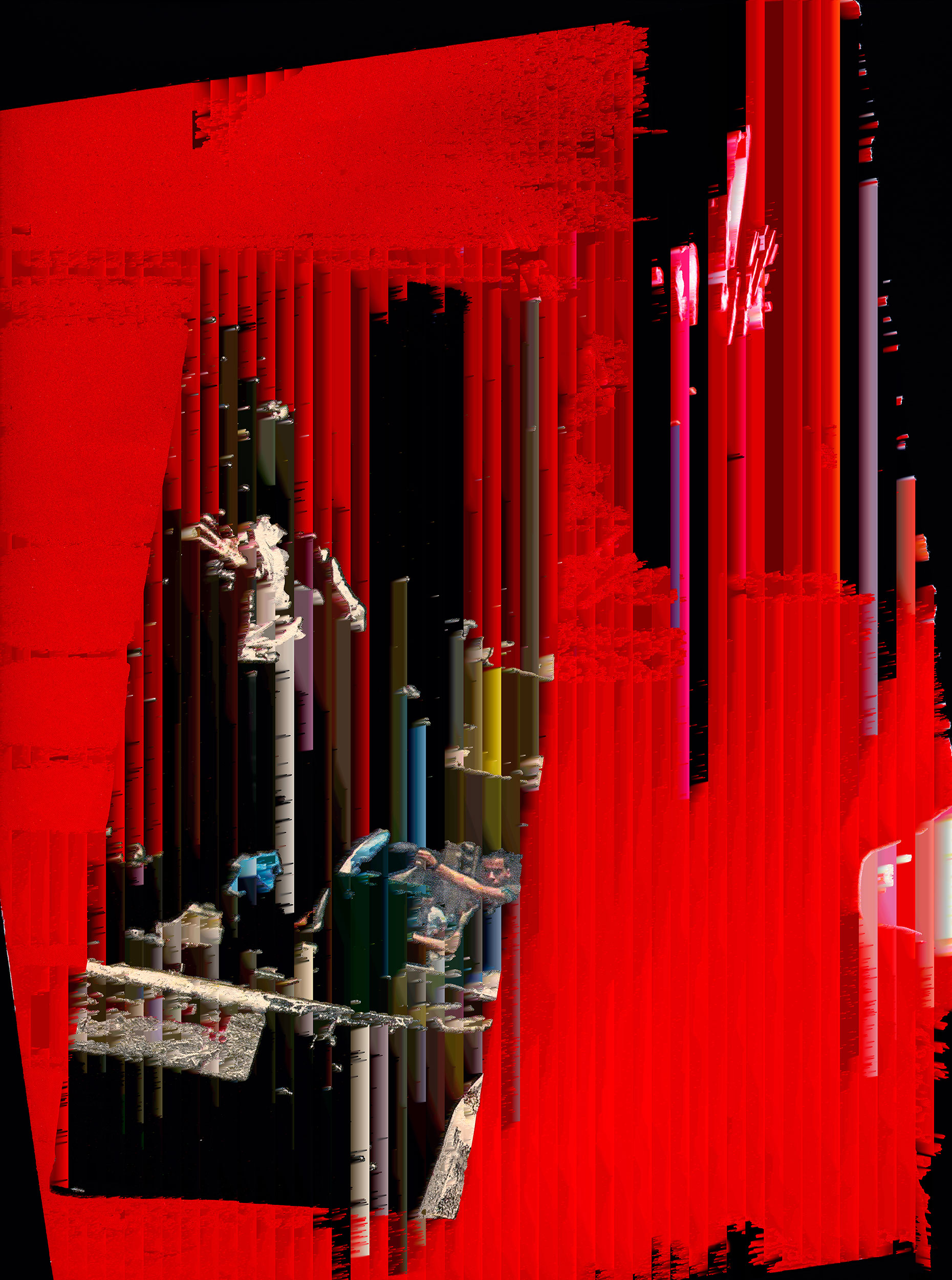
The enclasticines are scanner-derived photographic works exhibited as inkjet prints. Produced by the misapplication of dust and scratch removal software to found and assembled images, the works emerge through processes of misreading and misrendering. Sources drawn from print media, advertising, reportage, and digital circulation are subjected to an explicitly technological form of interference, resulting in images that oscillate between excavation and erasure, analogue and digital. These fractured surfaces resist legibility, inaugurating states of rupture, contamination, and temporal slippage that complicate photographic indexicality.
In contrast, the Disport works consist of unmodified photographic tripods deployed as sculptural and architectural elements. Presented ‘blind’, each tripod is activated through attachment—affixed to floors, walls, ceilings, or to other tripods—yet never to a camera, recording or surveillance device. The tripod, a tool designed to stabilise vision, is repurposed: much freer, less stable, more obstructive. Across fixed and variable stagings, the Disport works propose abstraction as a spatial and behavioural condition rather than an optical one.
Together, these bodies of work articulate a sustained inquiry into systems of support, failure, and mediation. Abstraction is approached not as a withdrawal from the world, but as a means of reconfiguring how images, objects, and bodies operate within it.
Christian Capurro is an artist, photographer, and moving-image maker, based in Melbourne, who has exhibited extensively in Australia and internationally, including at the Queensland Art Gallery | Gallery of Modern Art; TarraWarra Museum of Art; Heide Museum of Modern Art; Artspace; Institute of Modern Art; Australian Centre for Contemporary Art; Centre for Contemporary Photography; Museum of Contemporary Art Australia; Massachusetts Museum of Contemporary Art; and the Venice Biennale. His work is held in major public collections, including the National Gallery of Australia, Art Gallery of New South Wales, QAGOMA, Art Gallery of Western Australia, and the National Gallery of Victoria.