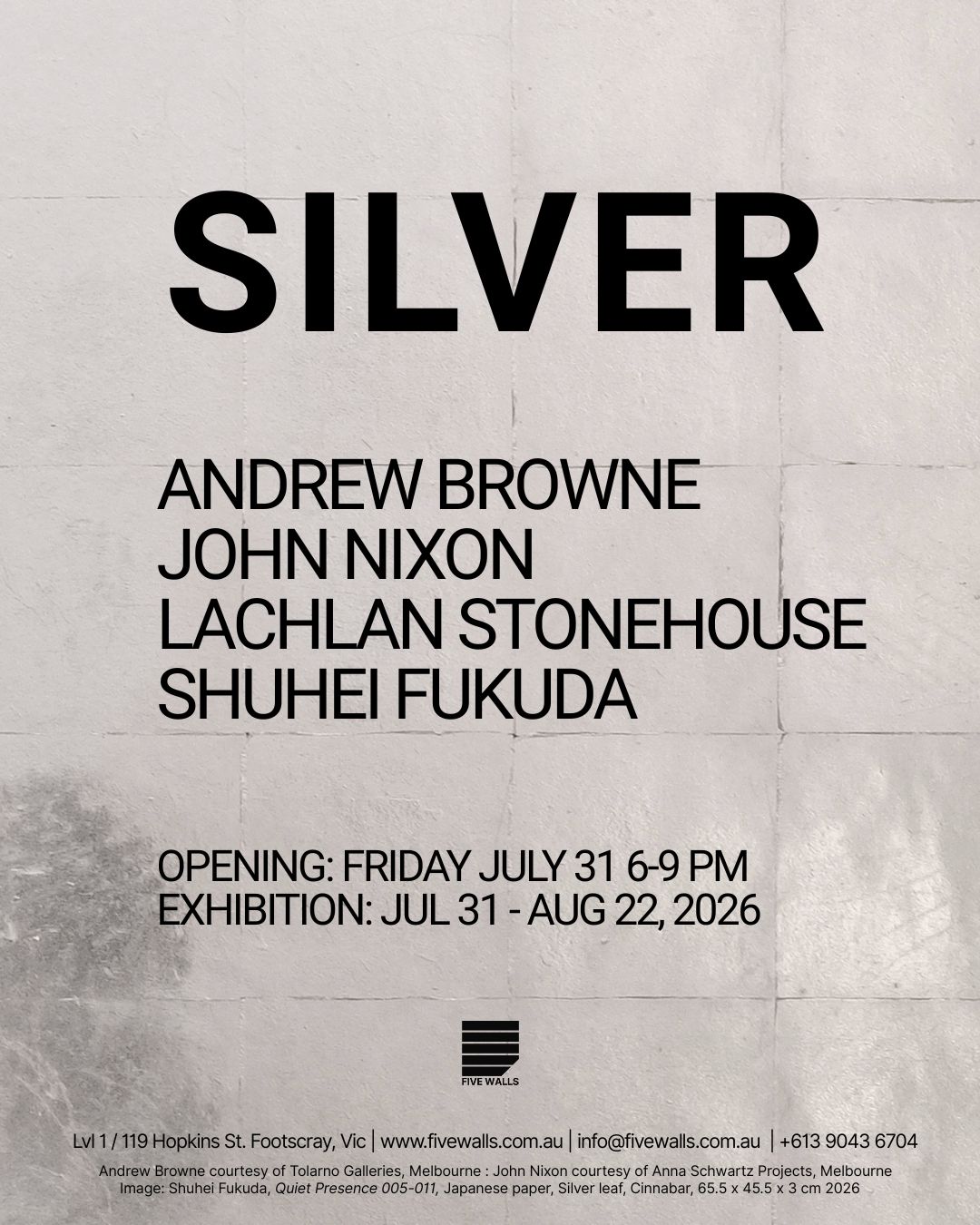
SILVER
Curated by Aaron Martin
ANDREW BROWNE
JOHN NIXON
LACHLAN STONEHOUSE
SHUHEI FUKUDA
July 31 – August 22, 2026
Silver is less a colour than a condition of light. It exists in continual negotiation with its surroundings, changing with atmosphere, reflection and time. Never entirely fixed, it oscillates between presence and absence, surface and depth, object and perception. In this exhibition, silver becomes an active field through which material, space and experience are brought into relation.
Across the practices of Andrew Browne, John Nixon, Lachlan Stonehouse and Shuhei Fukuda, silver is approached not as a shared aesthetic but as a conceptual proposition. It reflects, absorbs and transforms. It carries associations of industry and technology, ritual and ornament, the celestial and the everyday. Simultaneously reflective and elusive, silver resists certainty, continually returning the viewer to the act of looking itself.
For John Nixon (1949–2020), whose lifelong investigation of the monochrome remains a significant contribution to Australian abstraction, colour functioned as a point of departure rather than conclusion. His practice sought to reduce painting to its essential conditions, stripping away narrative and representation to reveal the possibilities of material, form and process. Through his rigorous yet experimental approach, Nixon explored the monochrome as both an idea and an ongoing field of enquiry. Silver extends this investigation, occupying the fertile space between neutrality and luminosity, where colour becomes not an image, but a proposition — a way of thinking through the fundamental conditions of art itself.
Lachlan Stonehouse (b.1999) similarly examines the fundamental structures of painting through the language of repetition, pattern and the grid. Drawing upon the legacies of Modernism, Minimalism and Post-Minimalism, his meticulously constructed surfaces merge hand-made and fabricated processes to produce optical rhythms that shift with changing light. The reflective qualities of silver heighten these perceptual effects, activating the surface as something continually experienced rather than simply observed.
Andrew Browne (b.1960)’s paintings inhabit a quieter, more poetic register. For decades his work has explored the intersection of the natural and the constructed world, where illumination, atmosphere and the poetics of the nocturne become vehicles for psychological reflection. Hovering between representation and abstraction, Browne’s restrained surfaces evoke landscapes that feel at once familiar and estranged. Silver becomes a vehicle for this ambiguity, capturing fleeting moments of light while suggesting the spectral, the remembered and the unknowable.
In Shuhei Fukuda (b.1997)’s practice, silver is both medium and collaborator. Working with traditional Japanese materials and techniques, he embraces the inherent instability of silver leaf, allowing it to tarnish through its interaction with air, humidity and sulphur. Rather than resisting change, Fukuda understands transformation as the work’s essential condition. Time is not represented but materially inscribed, with each work becoming a record of the ongoing relationship between nature, material and human intervention. His works propose an Eastern understanding of impermanence, where beauty emerges through continual transformation rather than permanence.
Silver has long occupied an ambiguous position within art and culture. It is the colour of mirrors and machinery, precious objects and industrial manufacture, the moon, memory and preservation. It suggests both permanence and impermanence: valued for its brilliance, yet destined to oxidise and change. Its reflective nature denies a singular image, instead incorporating its environment and those who stand before it.
Although each artist approaches abstraction from a distinct position, all are concerned with the capacity of materials to generate meaning beyond representation. From Nixon’s enduring exploration of the monochrome, to the disciplined logic of Stonehouse’s grids, Browne’s atmospheric investigations of light and perception, and Fukuda’s evolving relationship with material transformation, the works invite sustained attention to process, perception and duration.
Rather than presenting silver as a unified symbol, the exhibition proposes it as a mode of encounter. Each work asks the viewer to attend to subtle shifts in light, material and time, revealing perception itself as something contingent and continually unfolding. Silver emerges not simply as a colour, but as a living surface where reflection, transformation and observation converge.
Aaron Martin, 2026
Andrew Browne appears courtesy of Tolarno Galleries, Melbourne
John Nixon appears courtesy of the Estate of John Nixon and Anna Schwartz Projects, Melbourne
All images by Simon Strong photography.